Sunday, November 25, 2018

Go Buy Shadows in the Forest by ThinkFun!


Friends! You must go buy two (2) copies of this award-winning game SHADOWS IN THE FOREST! Get one for your family and one for a friend. Here are three (3) reasons why...

First, my family helped bring it to the United States!

Second, our game designer friend Josh’s company, ThinkFun, makes it. (They also make Rush Hour, Roller Coaster Challenge, Gravity Maze, Laser Chess, and many other super fun puzzle games that make you think.)

Third, it’s the most fun board game you can play in the dark.

You can find Shadows in the Forest at Target in the game section, Barnes & Noble, on ThinkFun’s website, and in Colorado at Jax Outdoor Goods, Into the Wind, and in other game stores and gift shops. And online, obviously.


At this time, you might have some questions. Let’s start at the beginning…

Maybe five years ago, I was looking for a cooperative board game to give to our family for Christmas. We had just discovered our first cooperative game, Hoot, Owl, Hoot! and thought it was fun. So I was scouring the internet looking for a new game when I stumbled across a game that had little trees and a candle that you played with in the dark. It was called Waldschattenspiel, which loosely translates from German to “Shadows in the Forest”. The idea was that you placed trees around a board, turned out all the lights, lit a candle, and placed these little gnomey/elfy guys in the shadows behind the trees. The candle was a hunter whose “lantern” would freeze the elves like deer in the headlights as he walked around the forest. The gnomes could only travel through the shadows to escape the hunter. I thought that was a cool idea and potentially a great game to play after sunset while car camping or backpacking. Problem was, the original game was created in the ‘70s and was only distributed minimally to the U.S. I tried a couple times to buy it from online used game stores and kept having my orders cancelled.

I decided to make it. I went to Hobby Lobby, bought some fabric, some paint, balsa wood, spray paint, some air-dry clay, and some tea light candles. I found a photo of the original Waldschattenspiel game board and recreated the shapes on my fabric playing board. Hours and weeks later, I had a working game that looked kinda cool (and which also rolled up and weighed about a quarter pound for backpacking). In the photo on this post, you can see our handmade version on the left and ThinkFun’s professional version on the right.

Late on Christmas Day 2016, I would venture to say Erin was charmed and the boys were delighted to play a candlelight game in the dark. It was a hit!

A few months later, it was time for our Annual Ski Trip with college friends. One of the original Ski Trippers is our friend Julie, whose husband Josh is a game designer for ThinkFun. Over the years, it’s become a tradition for Josh to bring prototype games from work to the Ski Trip to test out on us and get our feedback. So naturally, I brought along our homemade Shadows in the Forest to show Josh. (Quick aside: This is not the only game the Ski Trip has created. Some of you may have painful memories of “MegaBowl”.)

At first, I would say most people were less excited about the game than we were because the strategies of the game take a little time to reveal themselves. But after a few rounds, Josh changed from quiet (a state he is rarely in!) to inquisitive; the questions started flowing like this: “Sooo… have you played it with more elves?” Yes, yes we had. “And what if the hunter places the lantern first?” Yeah, we tried that, too. You could see his gears whirring. He started taking pictures.

A few months later Josh told us that ThinkFun tracked down the original inventor of the game in Germany. Games are copyrighted just like books, so in order to bring the game to the U.S., Josh had to travel to Germany to meet the inventor Walter Kraul (and his family) in his little cottage where he is still making games by hand.

Long story over: This fall, ThinkFun has brought Shadows in the Forest back from obscurity for you and your family and friends to enjoy this holiday season and perhaps while you are car camping.

When you play the game, think of us... and look us up in the rule book!

Friday, May 5, 2017

The Problem with Podcasts

Podcasting is having a Golden Age as the clunky interface of iTunes has been replaced by much sleeker push feeds like Stitcher, PocketCasts, NPR One, and other apps. At work, we have been enjoying this podcasting renaissance, both as listeners and as the people who put guests in touch with hosts. 

While podcasts have a ton of benefits, I have found through sponsoring a few that they are generally not good sales opportunities. People aren't buying stuff they hear about on podcasts.

Why? 

People love listening -- and that's about all they do with podcasts. 

I think podcast listeners are passive and, especially in endurance sports, doing something else at the same time as listening to a podcast. I mow the lawn and do housework while listening. 

But what I definitely do NOT do is buy anything after hearing a podcast or after listening to an NPR show.

The problem is location:


  • Where to get the show: I don't have to go anywhere to get a show! One of the beautiful qualities of podcasts is that they are pushed to me on my phone. I download most podcasts through PocketCasts -- and if the show ain't on PocketCasts, I ain't listening to it because I've gotten accustomed to being lazy and waiting for the show to come to me. For most shows, there is no one centralized location that I’m forced to go to in order to get a new episode. That means that I am never exposed to any potential advertising or merchandising. This is obviously a benefit for consumers of podcasts and for podcasts to quickly build big audiences, but it’s a drawback for podcasts who want to sell sponsorships or ads outside of the actual episode and for people who represent guests on shows.
  • Where I am when I’m listening: I’m in the car, I’m on a ride or run, or I’m bopping around the house doing something else. Podcasts are exceedingly interesting from a human interest perspective, but I have (so far) found them to be bad sales channels.


So I wonder: is there a way to make podcasting more lucrative for both podcaster and the guests? I’m not sure what it might be, but I think there’s untapped value available.

Thursday, May 2, 2013

PubWest BookLore: Social Media for Publishing Professionals

In mid-May, I'll be presenting with Melissa Taylor of Pinterest Savvy to talk about some ways publishers are using social media.

Hope you'll join us! If so, please RSVP to Kent at executivedirector@pubwest.org.

Thu, May 16, 2013 at 6:00 PM
Denver Press Club
1330 Glenarm Place
Denver, CO 80204

My part will focus on content marketing, which is using book content to sell books.

I’m going to talk briefly about online promo effectiveness and then spend some time on how I used WordPress, Facebook, and Twitter to promote:

This will include some gimmickry, SEO, meta-tagging, keywording, post timing, cross-posting, and poaching celebrity Twitter handles.

I’ll then compare the effectiveness of content marketing with traditional online advertising by using online metrics and book sales data.


Monday, March 18, 2013

Map of Valmont Park Disc Golf Course in Boulder, Colorado

Valmont Park in Boulder now has a disc golf course!

The Valmont Park Interim Disc Golf Course is a temporary 18-hole disc golf course in northeast Boulder. It's east of Foothills Parkway and west of Valmont Butte and the Valmont Post Office. The course's uninformative government web page describes the course as temporary; there are somewhat vague plans for a better, bigger course. (Obviously, we should be thankful for the course and its government web pages. Thanks, Boulder, Mike Lamb, John Bird, and the Mile High Disc Golf Club!)

Volunteers laid the course in November and December, 2012 and I played it for the first time with a friend last weekend. Being a total nerd and obsessive-compulsive organizer, I took my GPS watch and smartphone so I could offer the first online map of the course (and of course now I've just discovered this earlier, less complete jpeg map on the discgolfcoursereview website forum).

You'll note that this is not a particularly accurate map, but I hope it communicates the general idea that this disc golf course is a lot of fun. The first 9 holes meander amusingly around a hill. The back 9 asks the question, "Can you throw straight?" You'll note that I cannot. (I'd never played disc golf on a course before and there was a 20 mph wind most of the day.)

We played for 1 hour 10 minutes and tied at 79 strokes. We weren't in a hurry and we had many throws get waylaid by wind gusts. I think someone could easily play this course during a lunch break. And the Front 9 would be totally fun to tackle in half that time.

There's space for maybe 20 cars in the parking lot just east of the park. And Valmont Bike Park, maybe 50 yards north and east along Airport Drive, has parking spots available as well.

Water is unavailable on the course, so consider bringing a bottle. There's a seasonal port-o-let conveniently positioned near tee 12, just about when you'd need it.

Enjoy!

Valmont Park Interim Disc Golf Course
South of the intersection of Valmont and Airport Drive in Boulder, CO
Uninformative government web page for the course

Valmont Park Interim Disc Golf Course


Friday, November 16, 2012

The Merry Pilgrim

Thanksgiving dinner calls for an American lager or pale ale or perhaps a mellow pinot noir and gewurztraminer, but sometimes it's prudent to begin America's best holiday with a warm and wonderful injection of holiday spirit: a well-mixed cocktail. 

But Thanksgiving has a unique palate: savory, roasty, warm, sweet yet sincere, and satisfying. It's a full day of cooking and ovens and friends, a holiday well herbed and spiced. So perhaps a drink to complement those flavors is preferable to one that piles onto them. 

To me, a great Thanksgiving drink highlights that complementary minority of flavors, the tart cranberry, that only bright fruit that could refresh the northernmost New England people. 

A cosmopolitan? Too sweet, too citrus, too breezy for a heartfelt holiday about giving thanks. To drink vodka on America's most American holiday would be unthinkable. 

But bourbon! That's an American drink as American as apple pie and moonshine. The leathery, woody, savory-sweet warm spirit of the South mingling amicably with Maine's clean-living coldwater berry? 

YES.
 
The Merry Pilgrim

16 cranberries, chopped
1 tsp simple syrup (Don't Google it! 1 cup hot water + 1 cup sugar, dissolve, chill)
1 oz cranberry juice

1 oz bourbon (Wild Turkey for budgetary and thematic reasons, or: Maker's Mark, Woodford Reserve)
soak 15 minutes

then add:
1 oz cranberry juice
1 oz bourbon
3 dashes angostura bitters
ice
stir (don't shake!)
strain with a fine strainer
pour and garnish with a few cranberries

Thursday, May 31, 2012

A preview of Scott Jurek's upcoming book Eat & Run

For Scott Jurek, few things in life have come easily. And that’s why he’s the world’s best ultramarathoner. In his new book Eat & Run, Jurek reveals depth of character as he tells how sports offered a reprieve from a tough childhood spent as family caretaker in Minnesota’s backwoods. Running became his salvation, delivering him to the highest heights of a modernizing sport. Jurek’s journey shows him melding the best parts of those around him, grafting their toughness and attitudes about life, sports, and food onto his hardened athletic core.

The book’s race reports are its best feature as freelance writer Steve Friedman’s gritty, emotional writing style carries us along smoothly over the jagged terrain and rocky emotional struggles Jurek endures. Jurek puts us inside his head as he devours mammoth workouts in the mountains around Seattle and smashes course records at races like Western States and Badwater, often running brutal paces on torn ligaments and broken bones. Witnessing Jurek’s development as a person and philosopher-athlete transform his running performances into personal milestones more meaningful than any podium finish or new world record. Any runner will absorb Jurek’s subtle lessons about mental toughness and find invaluable his four-step process for handling crises.

Some readers might find the “Eat” parts of the book less fulfilling. While Jurek is clearly convinced that his vegan diet has carried him throughout his career, runners may find his workouts and racing more relatable than his clean-fuel diet. Jurek eats simply, yet the interjection of his somewhat involved recipes at the end of important chapters felt a little jarring.

Eat & Run is a fascinating and inspirational look at Scott Jurek, deepening the narrow portrait of him in Born to Run. Though many of us undoubtedly had an easier upbringing, Jurek’s inner fire and his transformation into the world’s best ultramarathoner are motivating reminders of why we run. Eat & Run will become a classic of ultrarunning lore. For runners and trailrunners, Jurek’s story is anthem.

Eat & Run will be available next week in bookstores and from its publisher Houghton Mifflin Harcourt. Learn more about Scott and his book at his brand-new website www.scottjurek.com.

Monday, March 26, 2012

A conservative argument for Obamacare: health care is a public good

I'm no Tea Partier, but I tend to believe in limited government and lower taxes. Still, after several years of on-again, off-again thought, I've decided that health care has become a public good. Public goods require government regulation and so I've decided that I'm in favor of Obamacare. Here's why:

If you show up with a broken arm at a hospital emergency room, a doctor will fix your arm. If you don't have insurance, you'll pay out of pocket. If you can't afford to pay cash, what happens? I'll be honest, I'm no expert on health care. In fact, I totally botched my FSA savings account set-up in 2011 and accidentally gave away $400 hard-earned dollars to that great big FSA account in the sky. (Use-this-or-lose-this, jerks!) But I do know that someone pays. There's no such thing as a free cast. If not the patient or her health care insurance company, someone is paying for the doctor's time, the x-ray, the cast.

I suspect the hospital is footing the bill. To stay in business, the hospital (or health insurers or whoever is paying) must therefore charge paying customers more. This is one reason health care is expensive. (Other reasons include our insanely expensive high-tech approach to health care, the fact that we too often treat the symptom (diabetes) instead of the cause (bad diet, obesity, lack of exercise), and the fact that too many of us are a bunch of non-exercising chemical-laced lard eaters.)

It's undeniable that those with insurance are subsidizing those who can't pay their bills. That's unfair. Everyone should have health insurance so I don't have to pay for the health care of others. The only way this will happen is through an act of the government, hence Obamacare.

What about the uninsured unpoor, those who have no insurance yet can cover individual health care expenses? What happens to them in a health disaster, like a car accident or disease? If Obamacare reduces the cost of healthcare insurance*, the uninsured unpoor win twice. For them, insurance will cover routine care and disaster care at less cost than today's premium rates.

What about the rich who have insurance? Well, they have insurance, so there will be no penalty under Obamacare.

*Will Obamacare make health insurance less expensive? I think it will and here's why:

1. Obamacare makes health insurance more like a public utility. The act limits how much insurers can spend on things other than health care. It also restricts how quickly insurers can raise rates (no more than 10% a year without regulatory approval), which sounds like awfully good news to me. I believe my family's monthly insurance payment grew around 30% last year. Electricity and water are cheap and, in time, I think health care costs will fall as well. In fact, pretty much anything that becomes broadly adopted becomes more affordable.

2. Supply and demand. The supply and demand effect requires a little more thought. Sure, more customers means more demand. There are a limited number of insurers. More demand, same supply = higher prices. However! The service of health insurance is not really the same as a good, i.e. there is not a limited supply of insurance. In fact, more insured customers should actually increase the amount of insurance available. More people are healthy than unhealthy. More people are paying more than they cost.

3. Obamacare will increase competition among insurers. Okay, okay, if everyone's required to have insurance, then won't insurers make out like bandits not having to compete for customers? I don't think so. There are so many uninsured or underinsured Americans -- and so many people unsatisfied with their insurers -- that the state-run health care exchanges will give consumers the power to change insurers -- for the first time! With the option of affordable health care that's not tied to an employer, consumers will eventually be able to treat health care like car insurance. And let me tell how you excited I would be to get rid of "open season" in exchange for lizard-inspired ad campaigns.

Finally, Obamacare could mean huge savings for small businesses. As this Yale- and Harvard-educated foreign policy expert notes in this article in TIME magazine, affordable health care from exchanges may mean that employers will be able to stop offering health care coverage to employees.

I get that conservatives object to Obamacare because it's an expansion of government. That's true. It is an expansion of government. But you know what? We spend 12% of our nation's GDP on health care right now, far more than any modern industrialized nation that has some variety of national health care, and it's not like we're healthier than similar countries that spend far less.

Health care has become a public good and public goods require regulation. Obamacare means no more freeloaders, everyone paying a fair share, and a more thoughtful way to run health care.

Tuesday, August 16, 2011

Fitness Myth Busting

The ever insightful New York Times is running a series of fitness myth-busting articles this summer, and they're worth a look.

First is this one about warming up before exercising. In short, sports science says endurance athletes don't need nearly as much warm-up time as they think. This explains why I like Bobby McGee's approach: walk 5 minutes, do some dynamic warm ups (like easy stretching but with continuous movement), build into the workout.

Second is this article about endurance sport's 10% rule. I've always thought the rule of thumb -- don't increase your training load more than 10% a week -- was really conservative. It turns out the rule might not have any basis besides tradition.

This article busts no myth: it says that your best middle-aged mile run time is a reliable indicator of your risk of heart disease late in life. "The exercise you do in your 40s is highly relevant to your heart disease risk in your 80s." Cool! Now that's a payoff I can really appreciate.

Even modest exercise keeps you sane and sharp instead of nutty and senile, according to this recap of a new study.

Those silly looking "toning" shoes? They don't do a thing.

Saturday, August 13, 2011

The Cucumber Martini: 5 Simple Steps to Enjoying an Ice-Cold Glass of Fresh Air

I have many favorite summer drinks: Pabst Blue Ribbon, Stella Artois, iced tea with lemonade, iced chocolate milk, a yogurt smoothie with frozen berries and salt. Some weekends require a drink with more muscle, but that doesn't mean giving up summery flavors. One of my favorites is the Cucumber Martini, which when properly made is like drinking an ice-cold glass of fresh air.


Step 1: Grow a cucumber.

Step 2: Slice off 5-7 disks. Drop one in a glass with ice.

Step 3: Stack the disks and slice into them.

Step 4: Add disks, ice, and 2 shots gin and shake, shake, shake.
My favorite gin for this drink is Hayman's Old Tom for its aromatic flavor and sweetness.

Step 5: Pour, keeping the cuke bits out of your glass. Enjoy!

Tuesday, August 2, 2011

Facebook Is Designing an iPad/Kindle Tablet Device

I'm speculating wildly here, but play along.


Push Pop Press makes interactive ebooks. Their ebooks are more app or self-contained website than ebook, really, but it seems that this sort of convergence of web and book is one possible direction for the written word and its various formats.

The About page for the site has announced that Facebook has acquired Push Pop Press.

This can only mean that Facebook plans to join Apple, Amazon, Google, BarnesandNoble.com, Kobo, Sony, Motorola, and the rest of the technologized world in offering some device that lets you read ebooks!

If this seems like a leap, just think about what that device might look like: it would be a walled garden device designed to funnel all your Facebook-enable social network channels into one device. It would play Facebook video, have a built-in web browser (FaceFox?), and have a store where users could buy licensed music, movies, and ebooks through Facebook's App Store... or FTunes? Fbookstore?

Brand it how you will, Facebook's IPO will launch it into the socially enabled content retail business.

Thursday, June 16, 2011

Valmont Bike Park Is Ole-Fashioned, Grinnin' Fun

I have just two things to say about the newly opened Valmont Bike Park because you should really experience it yourself.

1. It's got something for everyone.
2. I was grinning the entire time I was there. 

Ride it yourself! http://bouldermountainbike.org/valmontbikepark

I almost bit it on this stupid little thing. Man, am I rusty!

Tuesday, February 15, 2011

Run Well. Not Too Much. Enjoy It.

Running seems pretty clear cut: put one foot in front of the other, lean forward, switch feet, swing your arms to stay balanced, repeat quickly.

Just a few years ago, few runners questioned their habits. Runners wore cotton socks and the latest Nikes. The stretched before every run. They figured running injuries were bad luck. Orthotics were thought to cure all running pains. They drank a lot of water during races. Their feet hit the ground heel first.

In the past year or so, catalyzed by Christopher McDougall's book Born to Run, academics, coaches, and the running media have begun asking fundamental questions that seem to have begun a revolution in the sport. The well-read runner of today is dizzy with differences of opinion on footwear, stretching, nutrition, training, and running form. Nearly every aspect of running is under attack:


The sport has fractured into factions, with coaches, manufacturers, and academics all devoted to the sport yet unsure how to run. Runners are caught in the middle. Navigating running's new forks in the road is easier when you understand the sport's roadmap of ulterior motives.

Big name coaches spend years building careers by differentiating their approach from other coaches. When science finds a flaw in an approach, its adherents point to their years of athlete improvement. Nevermind that any coaching is probably better than none, that leading coaches attract the most inherently talented runners, that athletes might have run even better under a better training method. Coaches stick to their entrenched views.

Manufacturers are slaves to their customers. They will make what customers will buy. Successful products will become the basis for new products. Without some outside interference, manufacturers have little incentive to innovate when producing more of the same thing is more profitable than trying something new. Born to Run convinced enough runners that the "big shoe" status quo might not be ideal and soon after, minimalist shoes began to appear in stores.

Fortunately, there seems to be a common middle ground of accepted running truths, most of which have some scientific backing. Just as Michael Pollan offers food rules, here are three simple guidelines for confused runners: Run well. Not too much. Enjoy it.

RUN WELL

All the major run techniques - CHI running, Good Form Running, POSE Method, Natural Running, etc. - share a similar running posture that reduces the physical stresses of running on the body. Academic research shows that these techniques mimic many aspects of the way humans run without shoes. The technique is this:
  1. Land each footfall roughly under your hips. Running like this requires a short, quick stride rate. This shorter stride will reduce or eliminate heel striking -- when your heel hits the ground before the rest of your foot. Academics and coaches seem to agree that heel striking is the genesis of many running form problems and injuries. 
  2. Lean forward a bit, not from your neck or hips, but from your ankles. This sounds kind of impossible, but the idea is to avoid running with an upright posture that causes overstriding and heel striking.
  3. Run with your arms hanging lightly and loosely from your shoulder. Your arms should swing freely. It's okay for your shoulders to move front and back with each stride. It's not okay for them to bounce up and down. When your arm comes forward with each stride, your hand should not cross the center line of your chest.
  4. Look ahead, not down.

NOT TOO MUCH

Coaches say that the best predictor of running performance is the number of miles a runner runs. Those same coaches also say that the best predictor of the incidence of running injuries is the number of miles a runner runs. More miles means faster runners who are injured more often. Why? Practiced runners develop more efficient technique and they are simply more fit from more training. Yet runners who often run tired allow sloppy running technique to creep into their training. When the physical damage from too much bad running overcomes the body's ability to heal itself, runners break.

Runners should spend some time crosstraining and building strength. Cross training and strength training help runners avoid overusing those parts of the body required for running and helps strengthen and balance muscles so they can maintain good running technique longer during runs.

Don't run more than your body can handle. How will you know when you're running too much? See Rule #3.

ENJOY IT

Running writer Matt Fitzgerald has spent a lot of time thinking about how the brain interacts with the body. His books Brain Training for Runners and the more recent and more thoroughly developed book RUN: The Mind-Body Method of Running by Feel explore how enjoyment of a run is the brain's way of saying that the run was physically beneficial to the body. If you're having to drag yourself out the door because you've run yourself ragged, that's a sign that you're running too much. Back off until running is fun again.

Enjoyment offers some insight into the footwear debate, too. What little research has been done on footwear and running injuries has found that more comfortable shoes cause fewer injuries. That's not to say that we should run with pillows strapped to our feet, but that runners should probably buy new shoes based on comfort. Fitzgerald and others guess that our perception of one pair of shoes as being more comfortable than another is our body's way of indicating that the more comfortable shoes are more beneficial to the body. This isn't a foolproof method, though, because the comfort studies mostly compared pronation control against neutral shoes without considering minimalist or low-drop shoes or barefoot running. I like my low-drop Newton shoes because of the low drop; the heel is barely higher than the toe. I think this shoe design has helped to reduce my heel strike quite a bit -- it is certainly easier to land on the midfoot in my Newtons than in my high-drop Mizunos. And yes, I find the Newtons more comfortable.

Running in pain is obviously an indication that something is wrong. Danny Abshire's book Natural Running explains that pain and injury are symptoms of bad technique or overuse. Running should feel good, and if something hurts, that's a signal you shouldn't ignore. If muscles feel uncomfortably tight, stretch them gently until they are comfortable again. If your knee kills, run less until it feels better and then figure out a way to run that doesn't hurt. This will likely be one of the techniques I mentioned above in RUN WELL.

Physical and emotional enjoyment of running are the entire point of running, right? If you enjoy your running, you are doing it right. That seems like a clear-cut answer to any running debate.

Friday, January 28, 2011

The Unbelievable Niceness of Elites

Dear diary,

Today was a big day. I got to go for a run with two-time Olympian Alan Culpepper, and I met Scott Jurek, America's leading ultrarunner.

During the run with Alan and while talking with Scott, I was impressed by four things:

1. When Olympians run, their feet make no sound. Amazing. Try it sometime. Impossible.
2. Scott Jurek is a very tall man, surprisingly tall for a guy who regularly runs 100 miles at once.
3. People who run a lot, and I mean a lot, run with extremely consistent pacing.
4. Alan Culpepper's slowest workout pace is my 5K race pace.

Alan is now a coworker in the Boulder office of Competitor Group. Scott moved to Boulder to train for the Ultra-Trail du Mont-Blanc, a ridiculously hard ultramarathon, and he'd stopped by the office for a quick photo shoot. Over the past several years, I'd corresponded over email with both men, asking for their endorsement of several of our running and nutrition books. Fortunately, they liked all the books I sent them and both were gracious and generous with their support.

After today's run and run-in, it struck me that elite athletes tend to be really... nice! Sure, some athletes will blow you off, but most of the elites I've met in person (Alan, Scott, Chris Carmichael, Erin Mirabella, Tim Johnson, Joe Parkin, Karl Menzies, Bob Mionske, Michael Barry, Mark Plaatjes, Craig Alexander) have really been quite nice. Like nicer than the average person you might meet at a friend's dinner party. The athletes I've met have been nicer even than non-athlete sports professionals, though most I've met have been quite cordial as well.

How is that that such driven, singularly focused people are so nice? They're on top of the world, paid to do what they love, adored by fans. Athletes come and go, and they have to make the best of their 15 minutes. The pond of endurance sports is not a big one, so athletes rely on their sponsors, their popularity with fans, and on their performances. Sure, anyone can keep up a cordial act for the few minutes it takes to meet someone. Sure, I meet athletes under pretty good circumstances.

Yet not all of them have been nice. I think I know why: all the elites I've found rude have been removed from the height of their greatness, either by time or performance. Even after paying them large sums of money to appear at events, I was barely acknowledged by two cyclists who haven't ridden professionally in 30 years. A decade after the height of his career, I was ignored by one of the world's best ski racers despite holding a copy of the first American edition of his biography in my hand. Some former elite cyclists in Boulder have asked me rather brusquely for donations to their causes, despite any real connection to them.

These rude elites are not washed-up has-beens. All have found some way to spin their athletic success into comfortable careers. So why the rudeness?

Elite sports are the domain of the young. Having found success at a young age, untempered by the wisdom gained in failure, elites flame out of their sports before they are prepared to leave. As Joe Parkin has said, most cyclists don't retire. Most don't even know which race will be their last. Beaten and exhausted, they just quit. Most of us need to work for decades to find success. To have that pyramid turned upside down, to find success early and lose it so soon, to become a usual person after having been special, that must be a rude awakening.

What does it take to retire with civility intact? 

Tuesday, January 18, 2011

The Most Effective Email Ever Sent by a Social Network


Subject: Dave, 51 of your connections changed jobs in 2010.

Monday, January 17, 2011

What We Feel When We Run: a Review of Haruki Murakami's Book

What was I thinking?
This morning I finished reading Haruki Murakami's book What I Talk About When I Talk About Running. For a few years, it had seemed to me that the book was mentioned in the running media with the same reverence normally reserved for books like Lore of Running and Once a Runner. We're publishing our own running memoir this year, and having seen What I Talk About laying around the office, I thought I should read it. I expected it to be taut, maybe a bit mystical. I think I thought it would be for running what Tim Krabbe's The Rider is for cycling.

Just two chapters in, I was thinking about putting it down. At first, it felt like Murakami was rambling and spending too much time qualifying that this book was simply about what running was like for him. After 50 pages, I realized I was reacting to Murakami's complete lack of pretense. There is no artifice between writer and reader. Murakami writes plainly. When Murakami runs, you run. When he tires, you tire. It's not because Murakami's descriptions are lively. They aren't. He describes passing roadkill during a run from Athens to Marathon with as much pragmatism as those whose job it is to remove roadkill. The reader knows Murakami's experience as a runner because the reader is also a runner. The genius of What I Talk About is not the creation of an experience for the reader, but its evocation of experiences the reader has already had. There is no need for Murakami to describe the act of running because we fill it in for him. Instead, he describes the feelings his running brings out in him, and we feel them in our own way. This common experience of running becomes a conversation with Murakami. He says: here is how running makes me feel. Naturally, I thought about how running feels different to me. I thought about how running is the same for me a Murakami and how we are different in our running. Did Murakami plan on this being my reaction? Murakami made me realize that, though everyone runs by alternating the left and right feet, running is a different experience for each runner. The act of running evokes a unique response in each of us, and Murakami's book asks us to think about how running is for us.

Murakami's book is thought of by longtime runners as being particularly quotable, but I don't think this is particularly true. Parts of his book leave strong impressions, but the words themselves are not succinct. When searching for the book's title, Google auto-suggests adding the word "quotes" after it. Clicking on the top result brings you to a blog that quotes literature. The three What I Talk About quotes are over 3,500 words. Murakami writes in impressions. Yet he quotes someone early in the book, "In the act of shaving lies a philosophy." He explains that he feels any act repeated often comes to reflect the person repeating it. For Murakami, running and writing are deeply personal rituals, in part because he has run and written so much.

What I Talk About is really an improvised run. Murakami is an impulsive man, and he felt it time to write this book, so he did. I imagine him sitting at his sun-bathed desk in his open-air office in Hawaii and completing a sentence. He looks up and his eyes focus. Something has stirred in him and broken his stream of thoughts. There will be no more writing now. I think of him rising out of his chair, stepping tightly to his running shoes, which lie neatly next to the door, facing outward. He lifts off his shirt, stretching upward, breathing a deep breath and tingling in anticipation. He opens the door and, head down, begins his run. Murakami has no route in mind, no thoughts, just an urge to move. He must run until he is spent. As his body warms and his legs unspool, he is able to lift his eyes from their clouded writer's haze to see the ocean-side, the trees, the signposts easing past. He tells us what this feels like to him and we feel what it would feel like to us.

For Murakami, running is a moving experience, pardon the pun, and his experience has moved me. What I Talk About has made me think differently about running. I feel sad for those who run blankly or not enough to feel some hint of the depth Murakami draws from running. In the end What I Talk About is more than a description of what we feel when we run, more than a conversation among runners. Murakami describes how this act of running, repeated often, has come to reflect the person he is. He describes how running has challenged him to become better. In making me more aware of this process, Murakami and I will run together for a long time.

Wednesday, December 1, 2010

Google Nearly Ready to Launch Editions, Its Ebook Retailing Platform

If the Wall Street Journal prints it, it must be true. The WSJ says that Google is preparing to launch Google Editions this month.

Here are the most salient points for book publishers and webby consumers, in my opinion:

  • "Google Editions is set to debut in the U.S. by the end of the year and internationally in the first quarter of next year."
  • Editions users will "be able to access their Google accounts on most devices with a Web browser, including personal computers, smartphones and tablets." Google's open approach is welcome. Now you won't have to be tied to Apple or Amazon stores or gadgets to be able to read an enormous number of ebooks. In fact, the lack of a Google ebook reader really opens up the market to any device that has an internet connection. The web isn't dead, Mr. Anderson.
  • "Digital book sales are expected to more than triple to $966 million this year, according to Forrester Research, from $301 million in 2009." 
  • "Google is going to turn every Internet space that talks about a book into a place where you can buy that book," says Dominique Raccah, publisher and owner of Sourcebooks Inc. (Dominique was a keynote speaker at this year's PubWest conference.)
  • "Some independent booksellers that can't afford to open their own e-bookstores believe that Google Editions could be their gateway into the digital marketplace."
  • Google has scanned 10% of the world's 150 million scannable books.
  • "Spurred on by the launch of Apple Inc.'s iPad last April, more than 15 million e-readers and tablets will be sold by the end of 2010 in the U.S., compared with an estimated 2.8 million e-readers sold in 2009, Forrester predicts."
UPDATE 12/6: Annnd it's open! Check out Google's new ebook store. Here's the NYTimes.com analysis.

    Wednesday, November 24, 2010

    David Pogue Offers Food for Thought: Nothing Replaces Anything

    The New York Times technology columnist David Pogue celebrated his 10th anniversary column with a brief reflection on the past decade of technology.

    To me, it's hard to remember what the web looked like in fall 2000, much less digital cameras (did they exist?) and early forms of all the "convergence" gadgets available today that are just beginning to mash up the web and their legacy technologies.

    Pogue identifies some trends that ring of truth and longevity. The trend I found most relevant is this: Nothing replaces anything. Technology simply splinters.

    Pogue means that invention inspires copycats. From one iPod came dozens of competing mp3 players. None has "killed" the iPod. The technology simply splintered.

    There are exceptions, of course, but the ones I can think of without a decade of reflection seem mostly to be data storage formats: BetaMax, HD-DVD, cassette tape, CD, 8-track tape, vinyl, film cameras, etc.

    This should be a relief to purveyors of older standards. As long as your product experience is relevant, your product format can change without destroying your business. Hello? Book publishers?

    Friday, November 19, 2010

    It's On! The GoLite Warehouse (and Sample) Sale for 2 More Days


    WARNING! This sale is in a different location. There's more parking and it's easier than the Gunbarrel location. 

    Another difference from the usual GoLite warehouse sale, at least from what I've noticed at past sales, is that GoLite is selling both new product and samples. Samples are just that, sample products that sales reps take from store to store so product buyers can see the goods. Sample sales are usually deeply discounted (in this case GoLite was selling them for around 80% off) and are generally sold as is.

    And here, my discount-hunting friends, is the fall 2010 GoLite Warehouse Sale price list.

    Monday, October 25, 2010

    Sitting Kills: For Your Heart, There Is No Faking Fitness

    In March, my life tally included a wife, a three-year old, and a condo. In two months, we sold our condo, moved into a rental place, had another kid, bought a house and moved in. During this time, I spent nearly 8 hours a day sitting at work, another few hours sitting at home (or packing boxes and lifting furniture), and the rest lying my back (sleeping). My exercise, other than walks to the park and wrangling kids, was running 3 miles or so every other day. I've been thin since birth, and my weight hasn't changed since 7th grade, so I consider myself reasonably healthy, even if I don't have the time I'd like to get more regular exercise.

    So the article "The Men Who Stare at Screens" on NYTimes.com was disheartening and a little scary. To your heart, it doesn't really matter how much exercise you get if you spend most of your time on your butt.

    "Men who spent more than 23 hours a week watching TV and sitting in their cars (as passengers or as drivers) had a 64 percent greater chance of dying from heart disease than those who sat for 11 hours a week or less. What was unexpected was that many of the men who sat long hours and developed heart problems also exercised...Their workouts did not counteract the ill effects of sitting...Your muscles, unused for hours at a time, change in subtle fashion, and as a result, your risk for heart disease, diabetes and other diseases can rise."

    If this seems alarming, you should read the rest of the article. Basically, the modern workplace forces the white-collared to sit all day. Modern home life allows us the free time to be entertained via screen. We've replaced the daily light-intensity activities of our grandparents with screen time. We've become "active couch potatoes."

    The study in the article relies on a measure called metabolic equivalent of task (MET). One MET is the amount of energy you burn lying down for one minute; it ain't much. Two METs would be twice as much energy as you would spend lying on the couch. I've wondered before if METs might be useful as a way to compare apples to apples efforts in different endurance sports.

    As is often the case with New York Times fitness coverage, the story merely criticizes, offering no remedy. It would be useful, for example, to suggest MET guidelines on an hourly basis, even if they are a "GuesstiMET" on behalf of one of the researchers. Surely there was some threshold of light exercise apparent in the survey results; people are not merely active or inactive and there must have been some correlation to their health.

    Anyway, you can download a list of daily activities and their MET score to help you make your own GuesstiMET of how often to take the stairs.

    The Compendium of Physical Activities Tracking Guide (pdf)

    UPDATE 1/15/11: The New York Times reports that screen time kills. The Well blog describes mounting evidence that, regardless of your exercise time, too much sedentary "activity" is very bad for your health. This is scary stuff for the white-collar class of professional sitters.

    How to Transpose Single-Cell Lists in Excel to Columns


    By actually using my head to think instead of as a suitable desk-banging object, I've finally solved a data-reformatting problem that has plagued me for years: how to switch a single-cell list into a column of individual cells. In other words, how to make cell A1 in the above Excel screen shot look like range A3:A7 in the below Excel screen shot without re-keying it all.


    The solution is a very easy find/replace, super-quick conversion to HTML, and then a copy/paste from a web browser back into Excel. 

    Check it! (Just click the images to see them bigger. I had to make them small to fit into this Blogger template.)

    Step 1: Copy the single-cell list (A1, in this case). Paste it into a notepad-like program. I prefer Notepad ++.


    Step 2: Open the find/replace dialog and find ";" and replace it with HTML paragraph openers and closers, like this:


    Finding and replacing all the semi-colons and replacing them with HTML paragraph tags will make the list look like this:


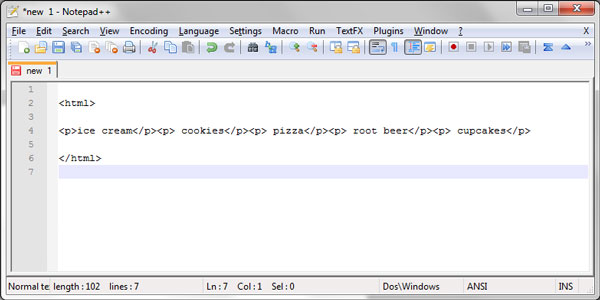
    Step 3: Finish up the HTML code. Since the phrase "ice cream" did not have a semicolon preceding it in the original Excel list, we need to manually add a paragraph opener before "ice cream". Likewise, the word "cupcakes" had no semicolon after it so we need to add a paragraph closer after it. Then we need to add the html opener tag before the list and the html closer tag after the list. Like this:


    Step 4: Save as a text file with the file extension ".htm" or ".html".

    Step 5: Open that HTML file in any web browser and it will display, TA DA!, as a list in a column! Why? Well, we basically converted all the semicolons (or commas or whatever character was dividing up the list items in cell A1) into paragraph marks. Then we save the list as an HTML file. A web browser reads HTML code just like a human reading a book -- on a single line from left to right -- but renders paragraphs in a column. Basically we told the web browser to do the reformatting for us! Score!


    Step 6: Copy and paste the list from your web browser into Excel, thank your browser for its hard work, then go take a coffee break -- you just saved yourself so much data-entry time that you deserve it!


    Obviously, the longer the list, the more time you'll save. Short examples like above are easy to re-key quickly. I just used it on a 128-item list of email addresses that an author had simply copy/pasted into an email. Pesky authors! Why does it always fall to the publisher to handle the formatting?

    You can combine the "text-to-columns" function with this technique to handle more complex lists. For example, if the list were person and title and separated by commas and semicolons like this:


    You would find/replace the semicolons as above. Once converted to HTML, this would render the list like this:


    You would copy/paste this into Excel, then highlight these cells and convert "text-to-columns" using commas as the delimiter. Voila!


    Naturally, the only situation for which this technique wouldn't work is if the list items were divided using only commas, like: Dave T., CEO, Erin T. CFO, Jon H., Lead Engineer, etc. Then find/replace has no way of knowing which commas you really want to convert to paragraph marks.